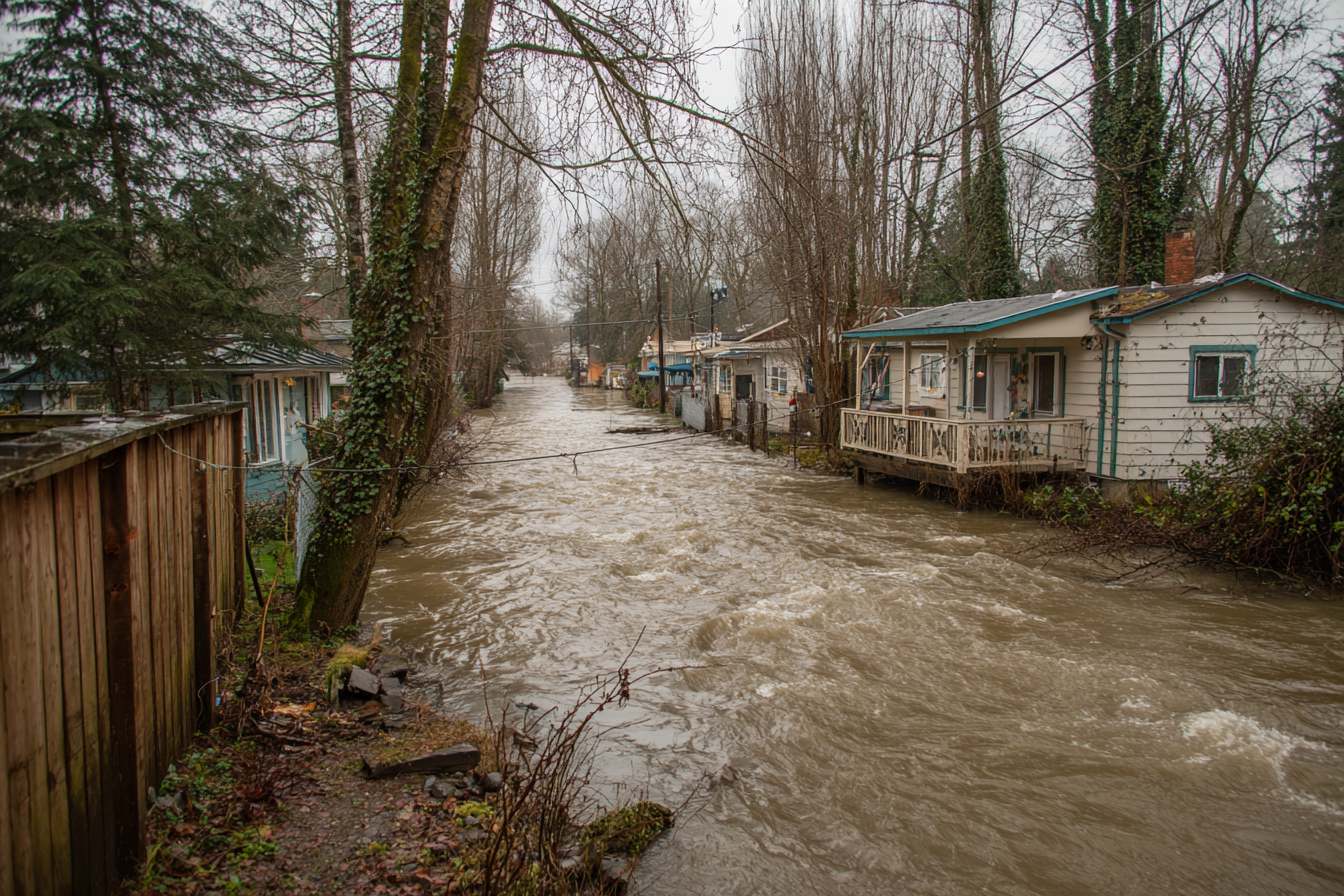
After water gets into a house, the first insurance question is simple: which policy is this? In Renton, with a river through the middle of town, a valley floor that ponds and plenty of aging plumbing, the answer is often "it depends on where the water came from." This guide lays out the usual answers. Your own policy is what actually decides, so read it and ask your agent.
The Short Version
| Where the water came from | Usually handled by | Notes |
|---|---|---|
| Burst or frozen pipe inside the house | Homeowners | Typically covered as sudden and accidental |
| Failed supply line, water heater, washer hose | Homeowners | The failed part itself often isn't covered, only the damage it caused |
| Cedar River or creek overflow | Flood policy | Excluded from standard homeowners policies |
| Street ponding or yard runoff coming in at grade | Flood policy | Usually counts as surface water, which homeowners policies exclude |
| Groundwater seeping through a slab or foundation | Often neither | Many policies exclude it; some flood policies limit basement coverage |
| A slow leak that ran for weeks | Often neither | "Continuous or repeated seepage" exclusions are common |
| Rain through a roof damaged by a windstorm | Homeowners | The storm damage opens the claim; the water follows it |
| Sewer or drain backup | Endorsement | Usually needs an added water-backup endorsement |
Why Homeowners Policies Exclude Flooding
Standard homeowners policies are written for sudden, accidental events inside the home. Flooding is different: one storm can damage thousands of homes in the same area at once, and private insurers have historically left that risk out. In the United States, most residential flood coverage is written through the National Flood Insurance Program (NFIP), run by FEMA and sold through regular insurance agents, with some private flood policies also offered.
For insurance purposes, flood damage generally means damage from surface water covering normally dry land, from overflowing rivers, rapid runoff or mudflow. That's why water that comes in under a door from a ponded street can be treated as a flood claim even though no river was involved.
What a Flood Policy Usually Covers
NFIP policies split coverage into two parts:
- Building coverage: the structure, its electrical and plumbing systems, furnace, water heater, built-in appliances, permanently installed flooring and cabinets.
- Contents coverage: belongings. This is separate, and renters can buy it on its own.
Basements get limited coverage under NFIP policies. Finished walls, floors and many belongings below grade are often excluded. If you have a finished lower level in a flood-prone spot, ask your agent exactly what's covered there.
New NFIP policies usually have a waiting period before they take effect, so buying one when the river is already rising generally doesn't help with that flood.
Water damage now, insurance questions later?
Start the cleanup first: (425) 584-1660.
Call (425) 584-1660What Adjusters Look For
Whichever policy applies, adjusters want to understand the cause and the extent. The restoration company's records help with both:
- photos and video of the water and the damage before anything was moved
- the failed part, if it was a pipe, hose or fitting (keep it)
- moisture readings and a sketch showing where the water traveled
- a list of removed materials with quantities
- the drying log showing readings each visit
A homeowner is generally expected to take reasonable steps to prevent further damage. That's the "mitigation" you'll hear about. Starting extraction and drying promptly is usually part of that duty, not a reason a claim gets questioned.
When Both Policies Are Involved
It happens. A winter storm floods the lower level from outside, and a pipe in the crawl space bursts the same week. Each source goes to its own policy. Tell both insurers about both events, and ask the restoration company to document the two areas separately, with photos, readings and removed materials, so each adjuster can see what belongs to their claim.
Documenting Before Anything Is Thrown Out
Flood and water claims often turn on proof of what was there. Before carpet, drywall and belongings go to the curb, photograph them, note brands and ages where you can, and keep a small sample of carpet and pad. Ask the restoration company to note the water line height in its photos. It's much easier to do on day one than to reconstruct later.
Questions
Does renters insurance cover water damage?
Renters policies cover your belongings, usually for the same kinds of sudden water events a homeowners policy covers. They generally exclude flooding. Renters can buy flood contents coverage separately. The building itself is the landlord's responsibility.
Will my homeowners insurance pay for the restoration company?
If the cause is covered, mitigation and drying are usually part of the claim, along with repairs. The insurer may compare invoices against the moisture records, so ask the company for copies.
Do I have to use the restoration company my insurer suggests?
Generally, no. Insurers may recommend companies, but in most cases you can choose your own. Check your policy and ask your adjuster.
In Renton Specifically
River flooding matters most near the Cedar in Maplewood and downtown. Surface-water claims come up on the flat valley floor in places like Kent. The rest of the city mostly sees homeowners-policy claims for pipes, water heaters and roofs.
When the Cedar River Rises
Where Renton's river floods have reached, and what cleanup looks like after the water drops.

What a Water Damage Cleanup Bill Is Made Of
The line items, and what makes each one bigger or smaller.